Churn Rate Analysis for Subscription Businesses
Every subscription business loses customers. At 5% monthly churn, a business loses nearly half its subscriber base in a year.1 Knowing the rate tells you how much the business is losing. It does not tell you why customers are leaving, which ones are most at risk, or what to do about it.
Churn rate analysis is the work of calculating that number and then making it actionable: which customers are churning, when they tend to leave, what they have in common, and what might stop them.
How to calculate churn rate correctly
There are two measures worth tracking: customer churn rate and revenue churn rate.
Customer churn rate counts the percentage of subscribers who cancelled in a period:
Customer churn rate = Customers lost Customers at start of period
Revenue churn rate (also called MRR churn rate) counts the percentage of recurring revenue lost:
MRR churn rate = MRR lost to cancellations MRR at start of period
If customer churn rate is higher than MRR churn rate, lower-value subscribers are leaving at a higher rate than high-value ones. The business is losing more customers than revenue — a relatively benign pattern. Retention efforts should focus on the lower tiers, but the financial impact is limited.
If MRR churn rate is higher than customer churn rate, high-value subscribers are churning disproportionately. Fewer customers are leaving, but they are taking more revenue with them. This is the more dangerous pattern and warrants urgent attention to the highest-MRR accounts showing risk signals.
This is why tracking both numbers is useful.
Monthly vs annual
Monthly churn is not converted to annual churn by multiplying by 12, but instead by exponentiating to 12, because the churn rate is repeatedly applied (multiplied) to each month. In this sense, churn compounds, which is why it is so impactful.
The correct annualisation is:
Annual churn rate = 1 − (1 − monthly rate)12
At 2% monthly churn, the annual rate is approximately 21%, not 24%.
Common calculation mistakes
Counting trials as subscribers. A customer who signs up for a trial and never converts is not a subscriber who churned. Include only paid subscribers in your denominator.
Mishandling pauses. A subscription on pause is not churned. Treat it as active until it cancels or expires.
Using end-of-period counts. Divide by the subscriber count at the start of the period, not the end. Using the end-of-period count excludes the customers who cancelled from the denominator, the very people you are trying to measure, and understates churn as a result. This is a form of survivorship bias.
Connect Stripe in minutes so you can see which customers are at risk and save that revenue.
Start my free trial →Beyond the headline number
The easiest way to make progress on understanding churn is to break the rate down further, or to use a technical term, slice and dice it.
Cohort analysis
Cohort analysis groups subscribers by the period they joined and tracks their retention over time. It answers a question the headline rate cannot: are customers who joined this year churning faster than those who joined last year?
A cohort that drops 15% in month two and then stabilises is a different problem from one that churns steadily at 4% per month for a year. The intervention required is different in each case.
To run a cohort analysis:
- Group customers by the month they first paid.
- For each cohort, track how many are still active at month 1, 2, 3, and so on.
- Express each count as a percentage of the cohort’s starting size.
The result is a retention curve. Steep early drop-off indicates an activation or onboarding problem. Steady long-tail churn indicates that value delivery is breaking down over time.
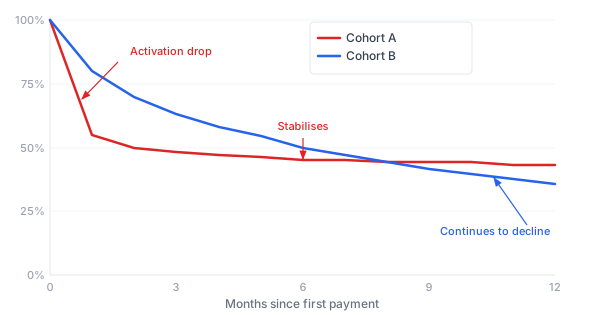
A useful complement is to compare first-month retention across cohorts over time. The overall churn rate blends subscribers at every stage of their lifecycle, so it shifts as the composition of the customer base changes: a period of fast growth inflates the rate because newer cohorts churn more; a slowdown can make it look like retention improved when it has not. Plotting month-one retention for each cohort separately shows whether new subscribers are activating and staying at a higher or lower rate than before, independent of what older cohorts are doing.
Segmentation
Churn often varies significantly across customer segments. Useful dimensions to check include:
- Plan tier. Do lower-priced plans churn faster? If so, the economics of acquiring them may be weaker than they appear.
- Acquisition channel. Customers acquired via promotion or discount tend to churn at higher rates than organic signups. You might look for a spike in churn when customers’ discounts expire.
- Time to convert. Customers who converted quickly from trial often retain better than those who used the full trial period.
- Business type. If you serve multiple customer types, they may churn for entirely different reasons.
Segmented churn rates tell you where to focus. A business with 3% overall churn that is actually 1% on annual plans and 8% on monthly plans has a different problem from one where churn is evenly distributed.
A high churn rate in a segment only matters if that segment is large enough to move the overall number. A segment with a 20% churn rate that accounts for 2% of your subscribers contributes less to total churn than one with a 5% rate that accounts for 60% of your base. When prioritising where to act, weight the churn rate by the segment’s share of subscribers or MRR, whichever one is more relevant to the business.
Segment contribution = segment churn rate × segment share of subscribers
Timing within the subscription lifecycle
Churn clusters at predictable points:
- Month 1–2: Activation failure. The customer signed up but never found value.
- Around month 12: Annual renewal decision. Many customers revisit the subscription at its anniversary.
- After a price increase: Any cohort active during a price change warrants close monitoring.
- After a failed payment: Unresolved payment failures are a leading cause of involuntary churn.
Understanding when churn peaks tells you when to intervene.
Leading vs lagging indicators
Churn rate is a lagging indicator. It measures what already happened. By the time a customer appears in your churn count, they have already left.
Leading indicators signal the decision before it is made. They let you intervene while there is still time.
The simplest leading indicators come from billing data, because billing events reflect customer behaviour without requiring product instrumentation or a customer success team.
Connect Stripe in minutes so you can see which customers are at risk and save that revenue.
Start my free trial →Billing signals that predict churn
Payment and subscription events are a natural place to look for leading indicators. Payment failures, plan downgrades, seat reductions, and discount acquisition all reflect changes in a customer’s relationship with the product — and are worth tracking to see whether they predict cancellation in your business.
The practical advantage is that this data already exists in your billing system, without requiring product instrumentation or user tracking.
Acting on churn analysis
Analysis is only useful if it leads to action.
Prioritise by MRR at risk. The same logic applies at the individual level as at the segment level: a small account with a high risk score matters less than a large account with a moderate one. Tailor your interventions to the revenue at risk, not just the risk signal.
Reach out before they cancel. For high-value accounts showing early warning signs, a direct message from a founder or account manager often changes the outcome. The goal is to understand what is going wrong and whether it can be fixed.
Apply discounts selectively. Discounts retain some customers and train others to wait for them. Use them where the relationship is strong and price is the stated issue. Avoid blanket win-back campaigns, because they are expensive and teach customers that cancellation is the path to a better price.
Fix involuntary churn first. Failed payments are the most tractable form of churn. Dunning emails, retry logic, and card expiry reminders recover a meaningful share of would-be churned revenue with minimal effort. Address involuntary churn before working on voluntary churn.
Track outcomes. For every at-risk account you reach out to, record what happened. This data improves future prioritisation and reveals which interventions work for your customer base.
Doing this automatically
Churn analysis is only useful if it runs, and is acted on, consistently. A one-off cohort query is not a retention process. What works is a repeatable routine: a ranked list of at-risk accounts, reviewed on a fixed schedule, with clear ownership of follow-up.
Sustaining that manually is difficult. Pulling data, running queries, and reviewing payment histories takes time that competes with other work. Automating the analysis, so the human input is reduced to the decision, makes consistent execution more likely.
Connect Stripe in minutes so you can see which customers are at risk and save that revenue.
Start my free trial →